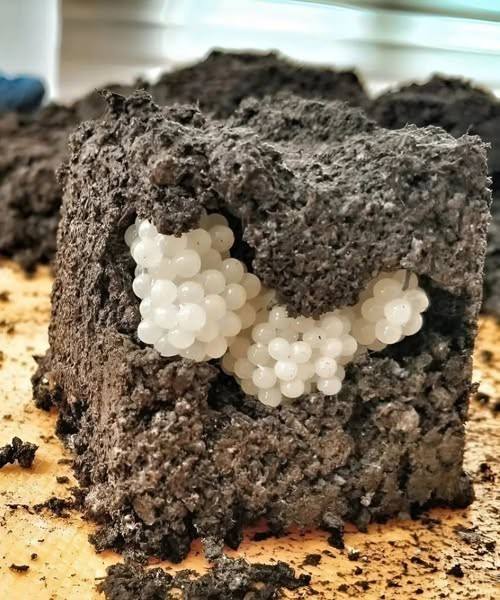
Brefeldia maxima is a fascinating organism known as a slime mold. Despite sometimes looking like a fungus, it’s actually not a true fungus; slime molds belong to the group Myxomycetes. Here’s a detailed overview:
Key Facts about Brefeldia maxima
- Common Name: True slime mold, or giant slime mold
- Size: Can form a single visible mass (plasmodium) up to 1 meter in diameter, making it one of the largest slime molds.
- Appearance:
- In its active plasmodium stage, it appears as a slimy, creeping mass that can be gray, yellow, or white.
- When it forms sporangia (fruiting bodies), it turns dark and crusty.
- Habitat:
- Found on decaying wood, leaf litter, or forest floors, mostly in temperate regions.
- Feeding:
- Feeds on bacteria, fungal spores, and decaying organic matter.
- Moves in a creeping fashion to engulf food (amoeboid movement).
- Life Cycle:
- Amoeboid stage: Microscopic single cells.
- Plasmodium stage: Large, multinucleated, visible mass.
- Sporulation: Forms sporangia for reproduction.
- Scientific Significance:
- Studied for its ability to solve mazes and optimize networks, because the plasmodium can connect food sources efficiently, inspiring research in biocomputing and network design.
- Discovery: Named after the German mycologist Oscar Brefeld.
💡 Fun fact: Despite looking like a giant blob, Brefeldia maxima doesn’t harm humans and is completely harmless. Watching it move over time under a microscope is surprisingly mesmerizing—it’s like a living, creeping network!
If you want, I can also explain how it “solves mazes” and why scientists are so interested in it—it’s pretty mind-blowing. Do you want me to?
